TDEE Calculator: How to Calculate Your Daily Energy Needs for Weight Loss

Have you ever followed a strict diet for 21 days only to find the numbers on your scales haven’t moved at all? It’s a common frustration that often stems from a simple misunderstanding of how your body actually uses fuel. Many people confuse their Basal Metabolic Rate with their total energy needs, leading to inaccurate calorie targets and those dreaded weight loss plateaus. Using a reliable tdee calculator is the first step toward clearing this confusion and establishing a baseline that reflects your unique lifestyle and activity levels.
We understand that managing your health is a deeply personal journey that requires both clinical accuracy and empathetic support. At Dr Weightmans, we draw on our heritage of operating 15 physical pharmacies to provide you with evidence-based guidance you can trust. This article will teach you how to calculate your Total Daily Energy Expenditure with precision, allowing you to create a weight management plan that’s both scientifically sound and sustainable. You’ll learn exactly how to adjust your daily intake for your specific goals and discover how our UK-regulated clinical team can provide the tailored support you need to achieve lasting results safely.
Key Takeaways
- Learn to distinguish between your Basal Metabolic Rate (BMR) and your total daily energy needs to build a more accurate and reliable weight management roadmap.
- Discover how the four pillars of metabolism—including activity levels and organ function—combine within a tdee calculator to reveal the exact number of calories your body burns every 24 hours.
- Master the art of organising a sustainable 10-20% calorie deficit whilst prioritising protein intake to ensure you lose fat without compromising vital muscle mass.
- Explore how clinically proven, UK-regulated treatments such as Wegovy and Mounjaro can help you manage appetite and bridge the gap between calculated data and real-world hunger.
Understanding TDEE: Your Personal Roadmap to Weight Management
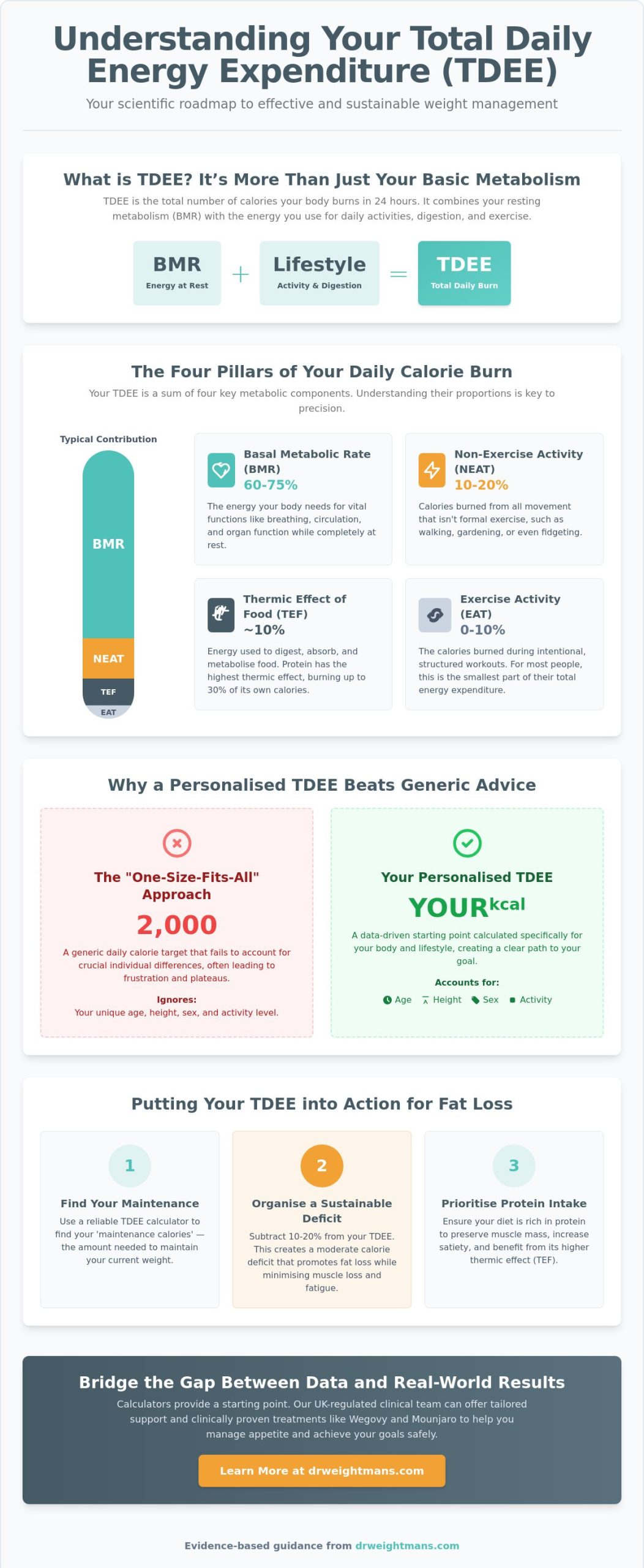
Taking control of your health starts with understanding how your body uses fuel. Your Total Daily Energy Expenditure (TDEE) represents the absolute number of calories you burn throughout a 24-hour window. It’s a comprehensive figure that accounts for everything from your heart beating while you sleep to the energy spent walking to the shops or working at your desk.
Many patients confuse TDEE with Basal Metabolic Rate (BMR), but they serve different purposes. Your BMR is the energy required just to keep your organs functioning at rest. In contrast, TDEE adds your physical activity and the thermic effect of food to that baseline. Using a tdee calculator helps you move beyond guesswork, providing a tailored starting point for any successful weight loss programme.
To better understand this concept, watch this helpful video:
While a tdee calculator provides an estimate rather than a laboratory-grade measurement, it’s an essential tool for setting realistic, achievable goals. Without this baseline, you’re essentially navigating without a map. By identifying your maintenance calories first, you can then create a precise energy deficit that supports sustainable fat loss without compromising your wellbeing. This empowers your weight management journey by giving you data-driven confidence.
Why TDEE is More Accurate Than Standardised Calorie Targets
The generic UK guideline of 2,000 calories per day often fails individual patients because it ignores personal biology. This one-size-fits-all approach doesn’t account for the fact that a 55-year-old woman and a 25-year-old man have vastly different metabolic needs. Factors such as your height, sex, and age significantly alter your daily requirements. For instance, muscle mass naturally declines as we age, which can lower energy needs by 2% to 5% every decade after 30. A personalised calculation ensures your targets reflect your unique physical profile rather than a national average.
- Age: Metabolic rate typically slows as you get older.
- Height: Larger bodies require more energy to maintain basic functions.
- Sex: Biological differences in muscle-to-fat ratios impact calorie burn.
- Activity: Your daily movement levels can change your needs by hundreds of calories.
How TDEE is Calculated: BMR, Activity, and Metabolism
Total Daily Energy Expenditure is the sum of four distinct metabolic components. Understanding these pillars helps you interpret the results of a tdee calculator with clinical precision. Your daily burn isn’t just about the time you spend in the gym; it’s a complex interaction of biology and behaviour.
- Basal Metabolic Rate (BMR): This represents the energy required for vital organ function. It accounts for roughly 60% to 75% of your total burn, powering your heart, lungs, and brain whilst you sleep.
- Non-Exercise Activity Thermogenesis (NEAT): This covers all movement that isn’t formal exercise. Walking the dog, gardening, or even standing instead of sitting can increase your daily burn by hundreds of calories.
- Thermic Effect of Food (TEF): Digestion requires energy. Protein is particularly metabolically expensive, as the body uses up to 30% of its caloric content just to process it.
- Exercise Activity Thermogenesis (EAT): This is the energy used during intentional workouts. Surprisingly, it often contributes the smallest portion to your daily total for most individuals.
The Role of Activity Levels in Your Calculation
Selecting the correct activity multiplier is vital for an accurate tdee calculator result. A sedentary profile applies to those with office jobs and minimal movement. Lightly active individuals typically manage 1 to 2 hours of light activity per week, whilst moderately active users engage in 3 to 5 days of purposeful exercise. People often overestimate their calorie burn during workouts by nearly 50%. Using a validated resource like the Forbes Health TDEE Calculator can help provide a realistic starting point for your targets.
The Science of Metabolic Adaptation
When you maintain a calorie deficit over several months, your body may respond by becoming more energy-efficient. This process can lead to a plateau as your BMR and NEAT naturally decrease to conserve fuel. Metabolic adaptation is the body’s natural survival response to reduced energy intake. If you feel your progress has stalled, you can empower your weight management journey by seeking tailored medical support to navigate these biological shifts safely.
Using Your TDEE to Organise a Sustainable Calorie Deficit
Once you’ve used a tdee calculator to determine your maintenance calories, the next step involves creating a manageable energy gap. A safe and effective approach involves subtracting 10% to 20% from your total daily energy expenditure. For instance, if your maintenance figure is 2,500 calories, a 15% reduction results in a daily target of 2,125 calories. This moderate reduction ensures you lose fat whilst avoiding the intense hunger or metabolic adaptation associated with more aggressive diets.
High protein intake is vital during this process. Clinical research suggests that consuming between 1.6g and 2.2g of protein per kilogram of body weight helps preserve lean muscle mass whilst you’re in a deficit. This ensures the weight you lose comes from fat stores rather than muscle tissue. To gain a complete overview of your health, it’s helpful to use a BMI calculator alongside your calorie tracking to understand what your body mass index actually means for your health. This allows you to monitor how your weight loss impacts your overall health category according to UK clinical standards.
Setting Realistic Expectations for Weekly Weight Loss
Aim for a steady loss of 0.5kg to 1kg per week. This range aligns with NHS recommendations and is significantly more sustainable than rapid weight loss methods. You should avoid “crash dieting” that takes your intake below your Basal Metabolic Rate (BMR). Eating fewer calories than your body requires for basic physiological functions, such as breathing and cell repair, can lead to nutrient deficiencies and long-term metabolic damage. Sustainable change is built on consistency, not deprivation.
Recalculating for Continued Success
Your energy requirements aren’t static. As your body mass decreases, your tdee calculator results will naturally shift because a smaller body requires less energy to function. To stay on track, you should update your data regularly:
- Recalculate your figures every time you lose 5kg of body weight.
- Adjust your targets if you experience a weight loss plateau lasting more than three weeks.
- Update your activity level if your daily movement habits change significantly.
Regular adjustments ensure your calorie target remains accurate for your current size and lifestyle, preventing progress from stalling as you get closer to your goal.
Ready to take the next step in your health journey? Empower your weight management journey today with our expert-led support and discreet service.
Beyond the Calculator: Empowering Your Weight Management Journey
Understanding your numbers through a tdee calculator is a vital first step, yet the reality of maintaining a calorie deficit often proves more complex than simple arithmetic. Biology frequently fights back against weight loss efforts; hunger signals and “food noise” can make sticking to your calculated targets feel like an exhausting battle of willpower. It’s common to feel frustrated when the numbers on the screen don’t easily translate to the habits in your kitchen.
UK-regulated treatments such as Wegovy and Mounjaro have transformed how we approach these biological challenges. These medications work by mimicking natural hormones to regulate appetite and increase feelings of fullness. By dampening cravings, these treatments help you consistently hit the calorie goals identified by your tdee calculator whilst reducing the psychological strain of dieting. This clinical support ensures your body works with you, rather than against you, as you pursue your health goals.
When to Consider Clinical Support
Weight management isn’t just about discipline; it’s about health. You might consider clinical support if you experience any of the following:
- Your weight remains stagnant despite a consistent 500-calorie daily deficit.
- Intense cravings lead to recurring cycles of restriction and overeating.
- Underlying health conditions make weight loss a medical priority for your long-term wellbeing.
Dr Weightmans provides a “Modern Traditionalist” approach. We blend the digital ease of an online clinic with the clinical expertise of our established bricks-and-mortar pharmacy network. This ensures you receive the safety and accountability of a physical pharmacy with the convenience of a modern, patient-centric service.
Start Your Journey with Dr Weightmans
Taking control of your health is a seamless process. It begins with a confidential digital consultation to ensure your chosen treatment is safe and appropriate for your medical history. Once approved by our clinical team, your prescription is dispensed from our pharmacy and sent via discreet express delivery.
You can buy Wegovy online UK through our regulated platform today. We don’t just provide medication; we act as a partner in your health, offering the professional oversight and pharmacy expertise needed for long-term, sustainable success.
Take Charge of Your Metabolic Health Today
Understanding your daily energy needs is the essential first step toward a healthier lifestyle. By using a tdee calculator, you gain a clear starting point for a sustainable calorie deficit that respects your body’s unique metabolic requirements. This isn’t just about a single figure; it’s about balancing your basal metabolic rate with your physical activity levels to ensure long-term success. Whilst the data provides the map, professional guidance provides the safety net you need to reach your goals safely.
Dr Weightmans brings clinical expertise from our established bricks-and-mortar pharmacy roots directly to your home. As a UK-regulated pharmacy dispensing over 200,000 items monthly, we provide the reliable care you need to manage your weight with absolute confidence. We offer tailored clinical support alongside discreet express delivery across the UK, ensuring your privacy is always protected. You don’t have to navigate these physiological changes alone.
Empower your weight management journey with Dr Weightmans
We’re here to help you turn these calculations into lasting, positive results for your future.
Frequently Asked Questions
Is it better to eat at my BMR or my TDEE for weight loss?
You should aim to eat at a level between your BMR and your TDEE to lose weight safely and sustainably. Your BMR represents the energy your body needs for basic functions at rest, which accounts for roughly 60% to 75% of your total daily energy expenditure. Consuming fewer calories than your BMR can trigger metabolic adaptation and muscle loss. A sustainable approach involves a 500-calorie deficit from your tdee calculator result, ensuring you provide enough fuel for vital organs whilst achieving steady progress.
How often should I recalculate my TDEE as I lose weight?
You should recalculate your TDEE every time you lose 2kg to 5kg of body weight or every 4 weeks. As your mass decreases, your body requires less energy to move and maintain itself. A 2021 study in the Journal of Applied Physiology highlights that metabolic rates shift as body composition changes. Regular updates to your tdee calculator figures ensure your calorie targets remain accurate, preventing the common weight loss plateaus that occur when your intake matches your new, lower maintenance level.
Can medications like Wegovy change my TDEE?
Wegovy and similar GLP-1 medications don’t directly increase your TDEE, but they influence your metabolic health during weight loss. Clinical trials like the STEP 1 study showed that participants lost an average of 14.9% of their body weight over 68 weeks. Whilst the medication primarily works by suppressing appetite, the resulting weight loss will eventually lower your TDEE. Dr Weightmans provides tailored support to help you manage these changes through UK regulated clinical consultations and personalised treatment plans that adapt to your body’s needs.
Why am I not losing weight if I am eating below my calculated TDEE?
You might not be losing weight because of inaccurate calorie tracking or temporary fluid retention. Research suggests that people often under-report their intake by 30% to 47%. Small errors in weighing food or forgetting liquid calories can quickly erase a deficit. Additionally, high cortisol levels or a 2,000mg daily sodium intake can cause the body to hold onto water. Tracking your progress over a 28-day cycle provides a clearer picture of fat loss versus temporary weight fluctuations caused by hydration or hormones.
Does a high-protein diet actually increase my TDEE?
A high-protein diet increases your TDEE through the thermic effect of food (TEF). Your body uses 20% to 30% of the energy from protein just to digest and process it, compared to only 5% to 10% for carbohydrates. Increasing your protein intake to 1.6g per kilogram of body weight can boost your daily burn by approximately 80 to 100 calories. This metabolic advantage helps you protect lean muscle mass whilst you empower your weight management journey with a science-backed nutritional strategy.