BMI Myths vs Reality: What Your Body Mass Index Actually Means in 2026

What if the most controversial number in your medical records is actually the key to unlocking life-changing healthcare? It’s completely understandable to feel frustrated when a simple calculation seems to ignore your hard-earned muscle mass or unique body shape. You aren’t alone in feeling judged by a single figure on a screen, especially when you are working hard to improve your wellbeing and fitness.
At Dr Weightmans, we believe in empowering your weight management journey with clarity rather than confusion. This article explains why the medical community in the UK continues to use bmi as a primary clinical standard in 2026. You’ll learn how this measurement acts as a essential gateway to regulated treatments like Wegovy, helping you understand exactly where you stand in the eyes of professional healthcare providers. We will also introduce more holistic methods to measure your success, such as waist-to-height ratios and metabolic health markers, ensuring you have a complete and reassuring picture of your health as you move forward.
Key Takeaways
- Understand the historical context of the index and why it remains a vital clinical standard for NHS safety and treatment eligibility in 2026.
- Discover how the bmi provides a consistent framework for UK pharmacists to safely prescribe and monitor modern weight loss treatments.
- Learn why common myths regarding muscle mass are often misunderstood and how your ethnic background affects your personal health risk levels.
- Identify the specific steps needed to move beyond a single number by integrating waist measurements for a more comprehensive health assessment.
- Empower your weight management journey by using regulated UK tools to establish a reliable baseline for your long-term health goals.
Beyond the Scales: Why BMI is Often Misunderstood
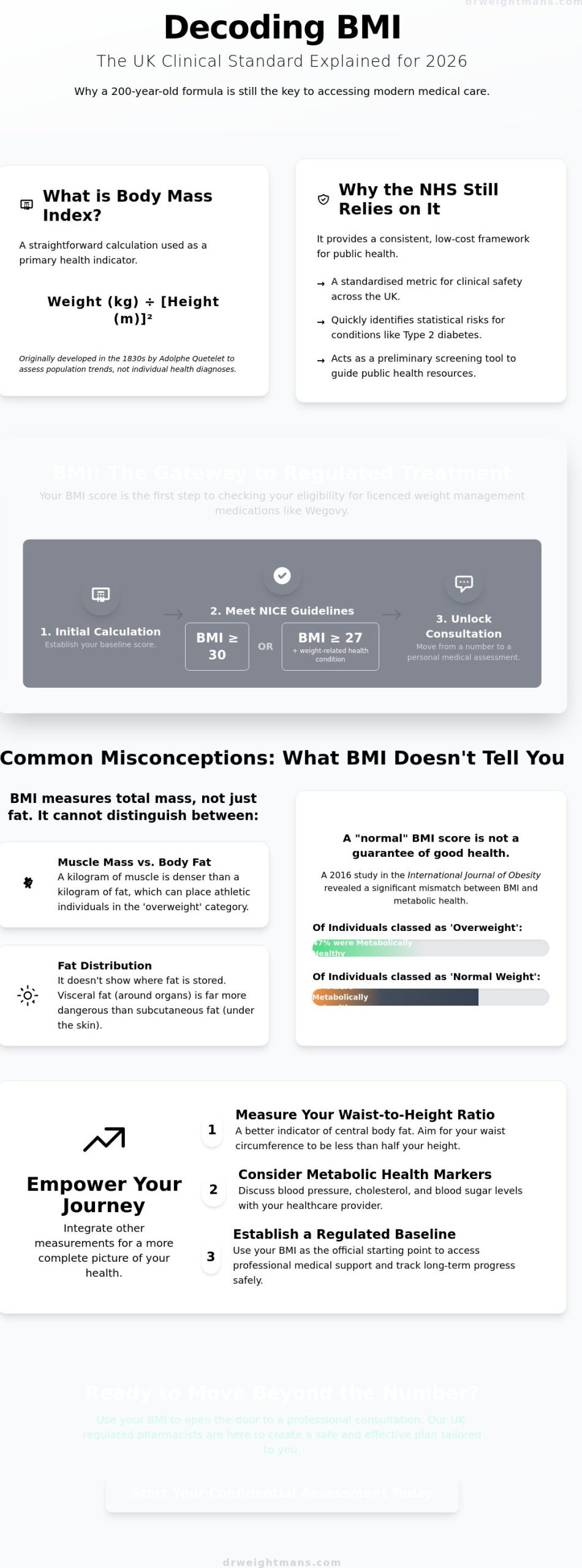
The mathematical formula for calculating Body Mass Index (BMI) is straightforward: weight in kilograms divided by the square of height in metres. Developed in the 1830s by Belgian mathematician Adolphe Quetelet, the index was never meant to diagnose individual health. Quetelet designed it to assess the “average man” within large populations to help governments identify social trends. Because it’s easy to calculate and requires no expensive equipment, it has remained the global standard for healthcare providers since the 1970s.
To better understand why this metric remains a topic of debate, watch this helpful video:
A common myth is that a “normal” bmi score is a definitive indicator of metabolic health. This isn’t always the case. A 2016 study published in the International Journal of Obesity revealed that nearly 50% of individuals classified as overweight were metabolically healthy, while 30% of those in the normal range showed signs of metabolic dysfunction. It’s a useful starting point, but it doesn’t account for the complexity of your body’s internal health.
The Difference Between Weight and Adiposity
BMI measures total mass, which includes muscle, bone density, and water, rather than just fat. Health risks are primarily driven by adiposity, or excess body fat, specifically its location. Visceral fat, which wraps around internal organs, poses a much higher risk for cardiovascular disease than subcutaneous fat found under the skin. Because the scale can’t distinguish between a kilogram of muscle and a kilogram of fat, it often misrepresents the health status of athletic individuals.
BMI as a Population Compass
The NHS relies on these figures to monitor national health trends and organise public health resources effectively across the UK. By tracking these shifts, the government can better allocate funding for preventative care and weight management services. BMI is a preliminary screening tool used to identify potential weight-related health risks rather than a comprehensive diagnostic test.
The Clinical Reality: Why the NHS and Pharmacists Still Use BMI
Despite the rise of advanced body composition scans, the NHS relies on BMI as a vital safety framework. It provides a standardised metric that allows pharmacists to prescribe medications with clinical precision across the UK. By using this height-to-weight ratio, healthcare providers can quickly identify statistical risks for conditions like Type 2 diabetes or cardiovascular disease. According to NHS guidance on BMI, the tool remains a primary screening method for identifying individuals who might benefit from medical intervention. It’s the first step in risk stratification, ensuring every patient receives a treatment plan tailored to their specific biological needs. This consistency is why a calculation is the first requirement in any professional medical assessment.
Eligibility for Weight Loss Injections
In 2026, NICE guidelines remain strict regarding weight management treatments to ensure patient safety. For modern medications like Wegovy or Mounjaro, the standard threshold for prescription is a bmi of 30 or higher. If you live with weight-related comorbidities, such as hypertension or sleep apnoea, this threshold drops to 27. These figures aren’t arbitrary; they exist to ensure the clinical benefits of the medication significantly outweigh potential side effects. This data-driven approach protects your health while providing a clear, regulated path toward sustainable weight loss.
Moving from Calculation to Consultation
Think of your bmi as the key that opens the door to professional support. At Dr Weightmans, your initial calculation acts as a gatekeeper. It’s the first question we ask because it sets the stage for a deeper, more personal medical assessment. We combine this figure with your medical history to determine the safest course of action. Once you’ve established your baseline, you can empower your weight management journey by speaking with a UK-regulated pharmacist. This transition from a simple number to a clinical consultation ensures your treatment is both safe and effective.
5 Common BMI Myths Debunked for a UK Audience
Many people view BMI as a flawed metric. While it has limitations, it remains a vital screening tool for our clinicians when used correctly. Understanding the truth behind common misconceptions helps you take control of your health journey with confidence and clarity.
The Muscle Mass Misconception
You’ve likely heard that BMI is useless because muscle weighs more than fat. This is technically true, but the “rugby player exception” rarely applies to the average office-based worker in the UK. Unless you’re training at an elite level for several hours a day, a high BMI usually indicates excess adipose tissue rather than lean mass. You can perform a simple check at home to verify this. If your waist circumference exceeds 94cm for men or 80cm for women, the muscle myth likely isn’t the reason for your score. High waist measurements are a direct indicator of visceral fat, which poses the greatest risk to your long-term health.
Ethnic Variations in Health Risk
The standard BMI scale isn’t a one-size-fits-all solution for our diverse population. NICE guidance updated in 2022 specifies that South Asian, Black African, African-Caribbean, and Chinese populations face increased health risks at lower BMI levels. For these groups, the threshold for being “at risk” of conditions like type 2 diabetes starts at a BMI of 23 rather than the standard 25. This variation exists because body composition and fat distribution differ amongst different backgrounds. Personalised thresholds are safer and more accurate for predicting clinical outcomes.
It’s also a mistake to think BMI is the only metric that matters. We recommend using it alongside your waist-to-height ratio. A healthy goal is to keep your waist circumference to less than half your height. Finally, don’t view your current score as a permanent label. Clinical evidence shows that a modest reduction of just 5% to 10% in your total weight can drastically lower your blood pressure and improve your cholesterol levels. Small, sustainable changes lead to significant clinical improvements.
If you are ready to make a positive change, we are here to help. Empower your weight management journey with our professional, UK-regulated clinical support.
Empower Your Journey: Moving Beyond the Number
Taking control of your health requires a shift from viewing a single figure as a verdict to seeing it as a helpful data point. You can begin this transition by following a structured, clinical approach that prioritises your long-term wellbeing over short-term weight loss.
- Step 1: Calculate your bmi using a regulated UK tool. Establishing an accurate baseline is the first move in any clinical journey. This figure helps healthcare providers categorise your initial risk profile.
- Step 2: Measure your waist circumference. This provides a vital second data point. The National Institute for Health and Care Excellence (NICE) suggests that your waist should ideally be less than half your height to reduce metabolic health risks.
- Step 3: Consult a UK-regulated pharmacy. Speak with experts like Dr Weightmans to discuss your medical options. Whether you require lifestyle advice or clinically proven treatments, a professional consultation ensures your plan is safe and tailored to your history.
- Step 4: Focus on Non-Scale Victories (NSVs). Track improvements that numbers cannot always capture. Better sleep quality, increased energy for daily tasks, and improved mood are all indicators that your health is heading in the right direction.
Holistic Health Monitoring
Numbers on a scale don’t tell the full story of your internal health. You should monitor your blood pressure and energy levels alongside your weight status to get a complete picture of your progress. Pairing your BMI data with an understanding of your total daily energy expenditure is equally important; using a tdee calculator to calculate your daily energy needs for weight loss can help you set accurate calorie targets that reflect your unique lifestyle and activity levels. For a deeper look at how different metrics compare, read our guide on BMI vs Body Fat Percentage. Tracking these variables helps you understand how your body composition affects your metabolic health and daily performance.
Starting Your Weight Management Journey
Dr Weightmans provides discreet, tailored support for those with a high bmi whilst ensuring your privacy remains a priority. We dispense over 200,000 items monthly across our network of 15 pharmacies, combining clinical scale with a person-centred approach. You’ll receive discreet express delivery and expert guidance through every stage of your treatment. Your index is a starting point for positive change, not a label of your worth or a limit on your potential.
Your Path to a Healthier Future
Your bmi is a helpful clinical indicator, yet it’s only one part of your unique story. Recognising that the NHS and pharmacists use this tool as a baseline helps you navigate medical advice with confidence. It’s about combining that data with expert clinical oversight to find a sustainable way forward. Dr Weightmans bridges the gap between traditional pharmacy trust and modern digital convenience. As a UK-regulated pharmacy dispensing over 200,000 items monthly across our network, we provide the safety and reliability you deserve. You don’t have to manage these complexities alone. Our team offers the professional support needed to turn insights into action whilst ensuring your privacy remains a priority through discreet express delivery. We’ve grown from humble beginnings to a network of over 15 physical pharmacies, meaning our digital service is backed by real-world accountability. Empower your weight management journey with a discreet consultation at Dr Weightmans. Taking the first step is often the hardest part, but you’re now equipped with the facts to make an informed choice for your long-term wellbeing.
Frequently Asked Questions
Is BMI accurate for athletes and bodybuilders?
BMI often provides an inaccurate reading for athletes and bodybuilders because it cannot distinguish between muscle mass and body fat. Since muscle is roughly 15% denser than fat, highly muscular individuals may be classified as “overweight” despite having low body fat percentages. We recommend using additional metrics like waist-to-height ratio or skinfold measurements. These tools offer a more tailored view of your physical health.
Why do South Asian people have different BMI thresholds in the UK?
South Asian individuals have different thresholds because they face a higher risk of type 2 diabetes and heart disease at lower weights. According to NICE guidelines updated in 2022, the “overweight” threshold for South Asian, Chinese, and Middle Eastern groups is 23 kg/m², rather than the standard 25 kg/m². Obesity is diagnosed at 27.5 kg/m². This clinical adjustment ensures patients receive early intervention and support tailored to their genetic risk factors.
Can I get Wegovy if my BMI is below 30?
You can access Wegovy with a bmi of 27 or higher if you also have at least one weight-related health condition. These conditions include hypertension, type 2 diabetes, or obstructive sleep apnoea. For those without these specific health issues, the standard requirement remains a score of 30 or above. Our UK-regulated clinicians review every consultation to ensure the treatment is safe and appropriate for your specific clinical profile.
How often should I calculate my BMI during my weight loss journey?
We suggest calculating your bmi once every four weeks to monitor your long-term progress effectively. Daily or weekly checks often lead to frustration due to natural fluid fluctuations that can shift your weight by 1kg to 2kg in a single day. Focusing on monthly trends provides a clearer picture of how your body responds to treatment. This approach empowers you to stay motivated without becoming fixated on minor, temporary scale changes.
What happens if my BMI is in the overweight category but I feel healthy?
A BMI in the overweight category is a screening tool rather than a definitive diagnosis of poor health. A 2023 study indicated that approximately 30% of people classified as overweight maintain healthy metabolic markers, including blood pressure and cholesterol. However, it’s a signal to review your lifestyle habits with a professional. We focus on your overall wellbeing, using these figures as a starting point for a confidential consultation about your future health risks.
Can I use BMI to track progress whilst taking Mounjaro?
You can use your bmi to track progress whilst taking Mounjaro, but it shouldn’t be your only metric. Clinical trials show patients often lose between 15% and 20% of their body weight over 72 weeks. While your score will decrease, tracking your waist circumference alongside it provides a better indication of visceral fat loss. Combining these figures helps you see the tangible impact of your treatment as you move through your weight management journey.