Calorie Calculator UK: A Guide to Planning Your Weight Loss Journey
Calorie Calculator UK: A Guide to Planning Your Weight Loss Journey
Written by Dr Weightmans, 25th April 2026

Why does a 1,500-calorie diet lead to steady weight loss for one person but total stagnation for another? You’ve likely felt the frustration of tracking every meal and weighing every snack, only to see the scales remain stubbornly still. It’s confusing to try and decode the technical jargon of BMR and TDEE while worrying that weight management just means constant deprivation. You deserve a plan that respects your unique biology rather than one that forces you into a generic, one-size-fits-all box.
This guide shows you how to use a calorie calculator to move past the guesswork and build a sustainable, clinically-backed strategy. We will help you define your personalised daily energy needs and explain exactly how your activity levels influence your progress. You’ll also learn how to recognise the moments when professional clinical support from a UK-regulated provider can offer the necessary bridge to your target weight. It’s time to empower your weight management journey with the clarity and professional confidence you deserve.
Key Takeaways
- Understand the fundamental principle of energy balance to fuel your body effectively whilst working towards your target weight.
- Utilise a calorie calculator to accurately determine your Basal Metabolic Rate (BMR) and create a personalised plan based on your daily energy expenditure.
- Learn how to apply the 500-calorie rule to achieve a sustainable and safe weight loss of approximately 0.5kg per week.
- Recognise the risks of crash dieting and how to avoid metabolic adaptation to ensure your weight management results are long-lasting.
- Discover when clinical support and GLP-1 medications may be appropriate to help manage appetite and overcome hormonal barriers to weight loss.
Understanding Calories: Your Body’s Energy Currency
A calorie isn’t a physical object you can touch. It’s a unit of measurement for energy. To understand what food energy is, think of calories as the fuel that powers every heartbeat, breath, and thought. Your body requires a specific amount of this energy to function at rest, a figure known as your Basal Metabolic Rate (BMR). When you consume more energy than your body requires for its daily tasks, it doesn’t simply disappear. Instead, your system efficiently stores this excess as adipose tissue, or body fat, to use during future periods of scarcity.
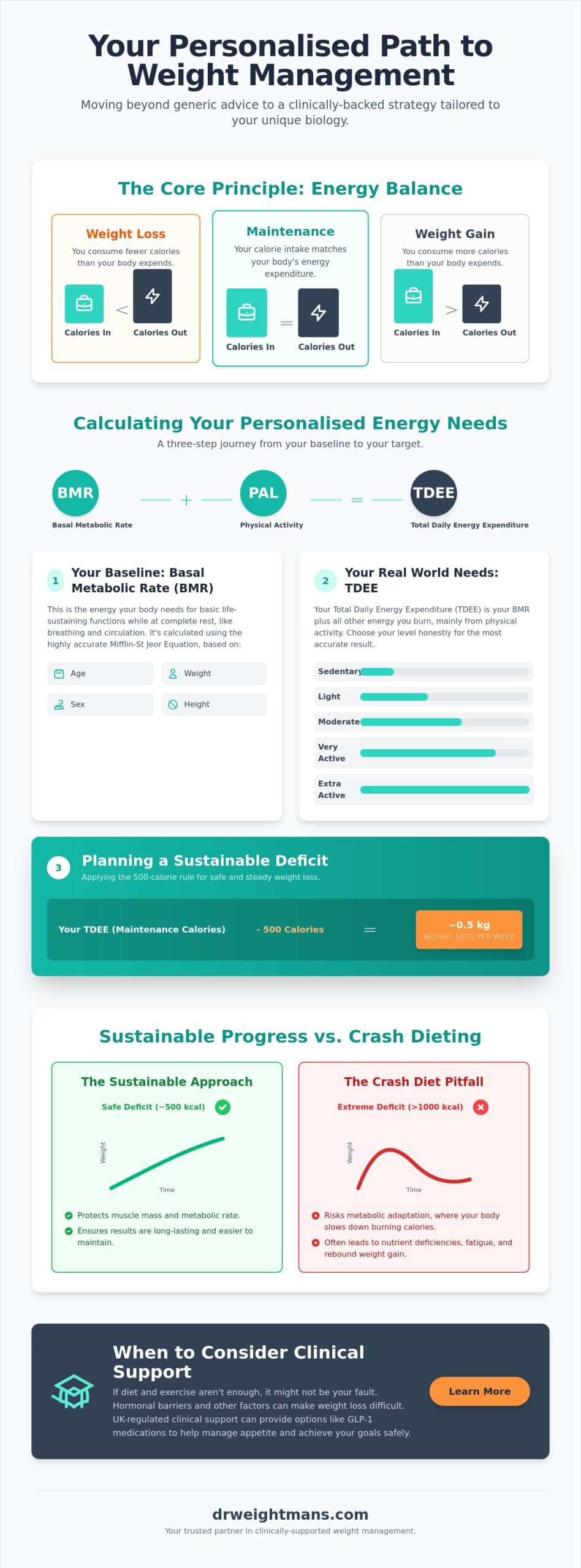
Achieving your health goals relies on the principle of energy balance: the relationship between calories in and calories out. Maintenance calories represent your unique baseline. This is the exact amount of energy needed to keep your weight stable. Identifying this number is the first step in any successful weight management plan. To find your maintenance level accurately, a calorie calculator is an essential tool for establishing a baseline before making any changes to your diet.
To better understand this concept, watch this helpful video:
Why ‘One Size Fits All’ Dieting Fails
Generic health guidelines often suggest a 2,000-calorie daily limit for adults. However, this figure is a broad average that ignores individual biological realities. Your metabolic rate is influenced by your age, height, and biological sex. For instance, muscle mass is more metabolically active than fat. This means a person with higher muscle density burns more energy even whilst sleeping. Factors like your activity level and hormonal health also dictate how much fuel you actually need.
Genetics play a significant role in how your body processes nutrients and manages energy. Relying on a generic number can lead to frustration or stalled progress. To empower your weight management journey, you need personalised data. Using a calorie calculator tailored to your specific metrics provides a much more reliable starting point. It moves you away from guesswork and toward a clinical, evidence-based approach to your health. This precision ensures you aren’t under-fuelling your body or unknowingly consuming a surplus.
How the Calorie Calculator Works: The Science of BMR and TDEE
Understanding the biological mechanics behind a calorie calculator is the first step toward sustainable health. Your Basal Metabolic Rate (BMR) represents the calories your body requires to maintain basic life-sustaining functions, such as breathing, circulation, and cell production, whilst at rest. To provide a precise figure, modern clinical standards utilise the Mifflin-St Jeor Equation. This formula is widely regarded as the most accurate method for calculating your daily calorie needs because it accounts for specific variables including age, sex, weight, and height.
Total Daily Energy Expenditure (TDEE) is the sum of your BMR, the thermic effect of food, and your physical activity level. While BMR is your “resting” figure, TDEE is the “real-world” number that dictates whether you lose, gain, or maintain weight.
Factoring in Physical Activity Levels (PAL)
Your TDEE fluctuates based on how much you move. This includes intentional exercise and Non-Exercise Activity Thermogenesis (NEAT), such as walking to the local chemist, hoovering, or light gardening. Activity levels generally fall into these categories:
- Sedentary: Little to no exercise, typical of office-based roles.
- Lightly Active: Light exercise 1-3 days a week.
- Moderately Active: Moderate exercise 3-5 days a week.
- Very Active: Hard exercise 6-7 days a week.
- Extra Active: Intense physical labour or professional athletic training.
Accuracy is vital here. Research suggests many individuals overestimate their activity levels by significant margins, which can lead to a smaller calorie deficit than planned. If you’re unsure, selecting a lower activity tier provides a safer margin for your progress.
The Role of Thermic Effect of Food (TEF)
Digestion is an active metabolic process. The Thermic Effect of Food (TEF) accounts for roughly 10% of your daily energy use. Different macronutrients require different amounts of energy to process. Protein is the most metabolic, using up to 30% of its own calories during the digestion process. In contrast, fats and carbohydrates require much less, typically between 3% and 15%. Focusing on high-protein meals can help you empower your weight management journey by slightly increasing your metabolic output and supporting muscle retention.
Planning Your Deficit: A Template for Safe Weight Loss
Once you’ve used a calorie calculator to establish your maintenance level, creating a sustainable deficit is the next clinical step. A reduction of 500 calories per day is the standard recommendation for achieving a safe, consistent loss of 0.5kg per week. Avoiding the trap of “crash dieting” is vital for long-term success. Consuming excessively low calories can trigger metabolic adaptation, where the body’s basal metabolic rate drops to preserve energy, often stalling progress entirely.
As your body weight decreases, your energy requirements will also shift. It’s best practice to recalculate your targets using a calorie calculator every 5kg to avoid a weight loss plateau. Utilising a digital food diary provides the data needed to make these adjustments. Use these tools as a compass, not a cage; if tracking becomes a source of anxiety, focus on portion control and food quality instead.
The Protein-First Framework for Satiety
Protein is the most important macronutrient when you’re in a deficit. It helps preserve lean muscle mass, ensuring the weight you lose comes from fat stores rather than functional tissue. High-quality protein sources like chicken breast, lentils, and white fish have a high satiety index, keeping you full between meals. Aim to include a palm-sized portion of protein with every meal to stabilise blood sugar and reduce cravings.
Hydration and Volume Eating
Volume eating is a strategy that uses low-calorie, high-fibre foods to fill your stomach. By loading half your plate with leafy greens, cucumbers, or cruciferous vegetables, you can eat larger volumes of food while staying within your limits. This “crowds out” more calorie-dense options and provides a psychological sense of abundance. Pairing this with adequate hydration is essential, as the brain often confuses thirst signals with hunger.
Take the next step and empower your weight management journey with professional clinical guidance from our UK-based pharmacy team.
Beyond the Numbers: Clinical Support for Weight Management
A calorie calculator provides a vital roadmap for your goals, but biology doesn’t always follow a linear path. Many people find that even when they’re eating the correct amount, weight loss stalls. This happens because factors like hormonal imbalances or metabolic adaptation can work against your efforts. When willpower alone isn’t enough to overcome these physiological barriers, clinical intervention offers a way forward.
Modern GLP-1 medications, such as Wegovy and Mounjaro, are designed to address the biological roots of hunger. These treatments help manage ‘food noise,’ the constant mental preoccupation with eating that makes sticking to a deficit feel like a battle. By pairing these clinical tools with a calorie-controlled diet, you’re not just guessing; you’re using a scientifically backed strategy to improve your long-term outcomes. It’s also worth understanding how your BMI figures into clinical eligibility for these treatments, as this measurement acts as a key gateway to regulated weight loss medications in the UK.
‘Medical weight loss isn’t a shortcut; it’s a biological support system for your lifestyle changes.’
The Dr Weightmans Approach to Empowered Health
Dr Weightmans blends the reliability of a long-standing physical pharmacy network with the convenience of a modern digital interface. As a UK-regulated provider, we prioritise your safety through a robust digital consultation process. This ensures that any weight loss injections you’re prescribed are appropriate for your specific health profile. We offer tailored support amongst a community of patients, ensuring you never feel alone. Every order is handled with care and sent via discreet express delivery to protect your privacy whilst you focus on your progress.
Taking the Next Step in Your Journey
If you’ve spent months tracking data in a calorie calculator without seeing the progress you expect, it might be time to seek professional help. Clinical support is particularly beneficial if you experience persistent hunger or have underlying health conditions that complicate weight loss. Long-term health monitoring by our experts ensures your journey is both safe and effective. You don’t have to struggle against your biology in silence.
Start your weight loss journey with a clinical consultation
Take Control of Your Health Journey
Understanding your body’s energy currency is the first step toward lasting change. By using a calorie calculator to determine your TDEE and BMR, you’ve moved past guesswork into evidence-based planning. Success isn’t just about a temporary deficit; it’s about building a sustainable lifestyle whilst ensuring your health remains the priority. When the numbers alone aren’t enough to reach your goals, professional clinical guidance provides the necessary bridge to success.
Dr Weightmans combines the heritage of a physical pharmacy network with modern digital convenience. As a UK Regulated Pharmacy dispensing over 200,000 items monthly, we provide the safety and expertise you need for effective weight management. You’ll benefit from tailored support and discreet express delivery, ensuring your path to better health is both private and efficient. You don’t have to navigate these changes alone when expert help is available at your fingertips.
Empower Your Weight Management Journey with Dr Weightmans
Your commitment to understanding the science of weight loss is a powerful foundation. We’re here to support you every step of the way as you work toward a healthier, more confident version of yourself.
Frequently Asked Questions
Is a 1,200 calorie diet safe for everyone?
A 1,200 calorie diet isn’t safe for everyone and often requires professional oversight for active adults. The NHS generally recommends a daily intake of 2,000 calories for women and 2,500 for men to maintain weight. Dropping to 1,200 can lead to nutrient deficiencies or fatigue unless it’s part of a clinically supervised programme. Always consult a healthcare professional before starting such a restrictive regime to ensure it’s appropriate for your height and health status.
How often should I recalculate my calorie needs?
You should update your figures in a calorie calculator every time you lose 5kg of weight. As your body mass reduces, your Basal Metabolic Rate also drops because there’s less tissue to support. Recalculating ensures your energy targets remain accurate for your current size and activity level. Staying on the same plan for too long can lead to a weight loss plateau as your deficit narrows over time.
Can I lose weight without counting every single calorie?
You can definitely lose weight without tracking every gram by using structured portion control methods. Many patients find success by filling 50% of their plate with non-starchy vegetables and 25% with lean protein. This naturally reduces energy intake without the stress of constant logging. Focusing on high-fibre foods helps you feel fuller for longer, making it easier to maintain a deficit whilst supporting your digestive health.
What happens if I eat below my BMR?
Eating below your BMR consistently can cause your body to break down muscle tissue for energy and slow your metabolism. Your BMR represents the minimum energy your organs need to function whilst at rest. If you drop below this level, you might experience hair thinning, cold intolerance, or extreme lethargy. It’s vital to fuel your body sufficiently to protect your long-term health and ensure your calorie calculator results include a safe margin.
Do calories from drinks count the same as food?
Calories from drinks count exactly the same as those from food, but they don’t trigger the same fullness signals in your brain. A standard 250ml latte can contain 150 calories, yet it won’t satisfy your hunger like a 150-calorie chicken breast would. High-sugar beverages can also cause rapid insulin spikes, which may affect your energy levels. We recommend prioritising water or tea to keep your daily intake within your target range.