Hair Loss Medication in the UK: A Complete Guide to Prescription Treatment
Hair Loss Medication in the UK: A Complete Guide to Prescription Treatment
By Dr Weightmans··Last reviewed: 1 June 2026
Hair loss is one of the most common conditions we see at Dr Weightmans – and one of the most misunderstood. The right treatment, started at the right time, can halt further loss and in many cases encourage meaningful regrowth. But not all hair loss is the same, not all treatment is suitable for everyone, and the sooner a clinical assessment is made, the better the outcome tends to be.
This guide explains how prescription hair loss medication works in the UK, who is eligible, what results you can realistically expect, and how to access treatment through a regulated online doctor service. If you are considering your options, this is the most important thing to understand first: the earlier you act, the more there is to work with.
Understanding hair loss – not all causes are the same
One of the most common misconceptions about hair loss is that it is a single condition with a single solution. In reality, hair loss has many different causes – and prescription medication is only appropriate for some of them.
Male and female pattern hair loss, known clinically as androgenetic alopecia, is the most common type and the one most responsive to prescription treatment. It is driven by the hormone dihydrotestosterone (DHT), which causes hair follicles to shrink progressively over time. Other causes of hair loss – including stress-related shedding (telogen effluvium), nutritional deficiencies, autoimmune conditions, and scalp disorders – require different approaches entirely.
This distinction matters, because patients who pursue prescription treatment for hair loss caused by something other than DHT-driven follicle shrinkage are unlikely to see results – not because the medication does not work, but because it is treating the wrong cause. A proper clinical assessment is the essential first step, not an optional one.
Key point: Prescription hair loss medication is most effective when started early. Once a follicle has been dormant for an extended period, regrowth becomes significantly harder. If you have noticed thinning or recession, seeking a clinical assessment sooner rather than later gives you the best chance of a meaningful outcome.
The consultation process at Dr Weightmans
What the online questionnaire covers
The process begins with an online consultation form covering your medical history, current medications, and the nature and extent of your hair loss. This information allows the prescriber to assess not just whether you are eligible for treatment, but which treatment is appropriate for your specific situation.
If anything in your responses is unclear or requires further information, the prescriber will contact you directly before making any prescribing decision. Nothing is issued without a proper individual assessment.
How eligibility is determined
The questionnaire is designed to identify the type and likely cause of hair loss, as well as any clinical factors that would affect which medication – if any – is appropriate. A patient whose hair loss has a non-hormonal cause, or who is at a stage where treatment is unlikely to be effective, will be advised of this rather than being prescribed medication that will not help them.
Important: gender and prescribing – Finasteride is not suitable for females under any circumstances. Women experiencing hair loss can be assessed for minoxidil (Regaine), which is appropriate for female pattern hair loss. Men planning to start a family in the near future should also avoid finasteride – this will be assessed as part of the consultation.
A first prescription that puts safety first
For new patients, Dr Weightmans offers an initial one-week supply as a tolerance assessment before a longer course is prescribed. This allows the prescriber to confirm the medication is being tolerated well before committing to a longer supply – a practical step that reflects the clinical reality that individual responses to medication vary.
Prescription hair loss medications available in the UK
Finasteride
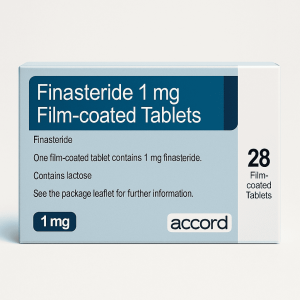
Men only · Oral tablet: Once-daily tablet. Blocks 5-alpha-reductase to reduce DHT by up to 70%, halting follicle shrinkage. Primary prescription treatment for male pattern hair loss.
Minoxidil (Regaine)
Men & Women · Topical Solution or foam applied directly to the scalp. Promotes blood flow to follicles and stimulates hair growth. Can be used alone or combined with finasteride in men.
How finasteride works
Finasteride works by blocking an enzyme called 5-alpha-reductase, which is responsible for converting testosterone into dihydrotestosterone (DHT). By reducing DHT levels by up to 70%, finasteride stops the hormone from continuing to shrink hair follicles – halting further hair loss and allowing existing follicles that have not yet become dormant to produce thicker strands over time. Finasteride is also used to manage other health conditions and it is specifically the 1mg dose which is used to treat hair loss. For more information on Finasteride you can read our dedicated Finasteride guide.
It is taken as a once-daily tablet and is available on prescription only. It is only suitable for men, and men who are planning to start a family should not take finasteride – this is assessed as part of the consultation process.
How minoxidil (Regaine) works
Minoxidil is applied directly to the scalp as a solution or foam. It works by widening blood vessels around hair follicles, increasing blood flow and delivering more nutrients to support hair growth. It is suitable for both men and women and is available without a prescription, though a clinical assessment ensures it is appropriate for your specific type of hair loss before it is recommended.
For men, finasteride and minoxidil can be used in combination – addressing both the hormonal cause of hair loss and supporting follicle activity simultaneously. This combined approach is often the most effective strategy for male pattern hair loss at an earlier stage.
A note on side effects
Finasteride is a well-established, licensed prescription medication with a strong safety record across decades of clinical use. A small proportion of patients do experience side effects, which can include changes to sexual function. Any patient with a history of or concerns about these side effects will be identified during the consultation and assessed as unsuitable for finasteride. If you have questions about this, your prescriber can discuss them with you directly before treatment begins.
What’s coming next: As with weight management, the treatment landscape for hair loss is evolving. At Dr Weightmans, we monitor new treatments as they become available and will make them accessible to patients as and when they are licensed and clinically appropriate.
What results to expect – and when
This is the area where patient expectations most often need managing – and where honest clinical guidance makes the biggest difference.
Finasteride begins working from the first dose. However, because hair grows in cycles, the effects are not immediately visible. Understanding the timeline helps patients stay committed to treatment during the period before results become apparent – which is precisely when many people give up.
- Week 1: Treatment begins. Finasteride starts reducing DHT levels from the first dose. No visible change at this stage. You may be provided with a weeks supply first to see if the medication is suitable for you.
- Month 1-3: Shedding slows. Existing hair loss begins to slow. Many patients notice less hair falling out. This is the first sign the medication is working.
- Month 3-6: New growth appears. New hair strands begin to emerge. Growth is gradual – fine strands that thicken over time as follicles recover.
- Month 6-12: Results become clear. The full picture of how well treatment is working becomes visible. Most patients who respond well see meaningful improvement by this point.
Hair loss treatment is a long-term commitment
This is the most important thing to understand before starting: there are no quick fixes. Prescription hair loss medication works – but only for as long as you take it. If treatment is stopped, the DHT that was being suppressed by finasteride returns, follicle shrinkage resumes, and any hair that regrew during treatment is likely to be lost again over the following months.
This is not a reason to avoid treatment – it is a reason to go into it with realistic expectations and a long-term plan. Patients who understand this from the start are more likely to stay consistent and more likely to see the best results.
Ongoing support and repeat prescriptions
Flexible supply to suit long-term treatment
Because hair loss treatment is a prolonged commitment, Dr Weightmans offers supply options between one and six months, so patients who are stable on their medication do not need to re-order frequently. This removes an unnecessary friction point from what is already a long-term process.
Every re-order includes the option to discuss treatment with the prescriber – covering how the medication has been tolerated, whether anything has changed, and whether any adjustment is needed. This is not a mandatory hurdle; it is an available resource. Patients who are progressing well can reorder straightforwardly. Those who have questions or concerns have a direct route to clinical input.
Access to your prescriber throughout treatment
If concerns arise between orders – whether about side effects, changes in hair loss pattern, or anything else – patients can contact their prescriber directly through the personal account chat function, by telephone, or by email. Clinical support is not limited to the point of ordering.
No subscription required: Dr Weightmans does not require patients to commit to a subscription. You can order as and when it suits you, in the quantity that works for your situation. For a long-term treatment, that flexibility matters.
Who comes to Dr Weightmans for hair loss treatment – and why
Who we treat
The most common demographic seeking hair loss treatment at Dr Weightmans is men between the ages of 30 and 55, though patients both younger and older come to us regularly. Many arrive after using our other services and finding the same standard of care they experienced there. Others come through word of mouth, social media, or having found us through search.
What most patients have in common is that they have noticed a change – recession at the temples, thinning at the crown, or increased shedding – and have decided to act on it rather than wait and see. That instinct is correct. Early intervention consistently produces better outcomes than delayed treatment.
Why patients choose an online doctor for hair loss
Hair loss is a sensitive topic. Many patients prefer to address it privately, without a face-to-face appointment, and with professionals they do not personally know. An online consultation provides that – a thorough clinical assessment, from a qualified prescriber, in a setting that feels comfortable and confidential.
Convenience also matters. Next-day delivery is available, and all orders arrive in discreet packaging with no branding or identifying information visible from the outside. For a condition that many people find difficult to discuss openly, those details are not trivial.
What makes Dr Weightmans different
Larger providers in this space have the brand recognition, but size brings its own problems – slower responses, less personal attention, and a transactional feel that does not sit well with a condition that affects how people see themselves. At Dr Weightmans, we are large enough to have built genuine clinical experience across a substantial patient cohort, but not so large that individual patients get lost in the system.
Pricing is competitive and consistent – there are no discounted first orders designed to lock patients in before prices rise. There are no subscriptions. There are no referral schemes. What there is, is a clinical team that responds promptly, treats every order as something that needs to be handled properly, and takes the time to give patients the information and support they need to stay on track with a long-term treatment.
Ready to find out if prescription treatment is right for you?
Complete a free online consultation with a UK-registered prescriber and get a clinical assessment tailored to your situation.
Summary: what to know before starting hair loss treatment
- Not all hair loss responds to medication – a proper clinical assessment is essential first
- Finasteride is for men only – women can be prescribed minoxidil (Regaine)
- Men planning to start a family should avoid finasteride
- Results take time – shedding slows in the first three months, new growth appears between three and six months
- Treatment is a long-term commitment – stopping medication is likely to reverse the results
- Earlier treatment gives better outcomes – act when you first notice change, not after significant loss
- Men can use finasteride and minoxidil in combination for the best results
- Clinical support is available throughout treatment, not just at the point of ordering