Finasteride for Hair Loss: A Comprehensive Guide to Results and Safety
Finasteride for Hair Loss: A Comprehensive Guide to Results and Safety
Written by Dr Weightmans, 23 April 2026

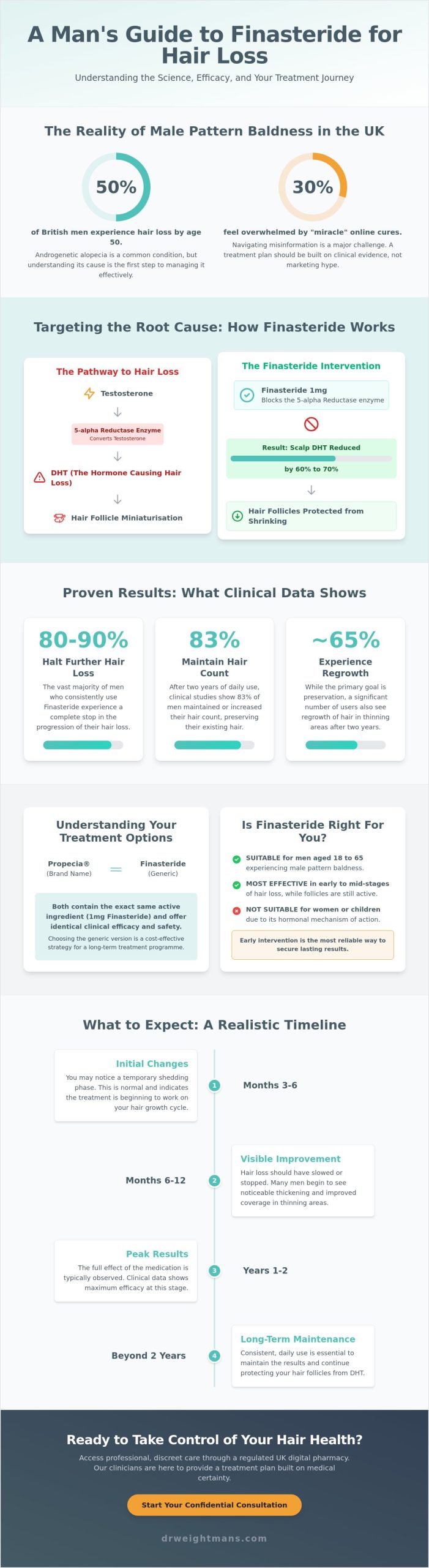
By age 50, approximately 50% of British men experience androgenetic alopecia, yet a 2023 survey revealed that 30% of those affected feel completely overwhelmed by the various “miracle” cures advertised online. It is natural to feel a dip in self-confidence as you notice thinning at the crown, particularly whilst the clinical evidence for finasteride is often buried under conflicting anecdotes. You deserve a treatment plan built on medical certainty rather than marketing hype.
We understand that managing your health is a personal journey that requires both empathy and professional expertise. This guide explains how this medication works to block the hormone responsible for follicle shrinkage, helping you to stop further loss and potentially regrow hair in thinning areas. You will learn about realistic timelines for improvement, supported by clinical data showing that 83% of men maintained their hair count after two years of consistent use. We also address safety concerns and potential side effects directly, providing the facts you need to make an informed decision. This overview provides a clear roadmap for starting a simple, discreet routine to reclaim your confidence and take control of your hair health.
Key Takeaways
- Discover how finasteride targets the hormonal root cause of male pattern baldness to prevent hair follicle miniaturisation.
- Understand the biological hair growth cycle and why a daily commitment is necessary to see visible improvements over several months.
- Explore the clinical safety profile of the 1mg dose to help you make a balanced, informed choice about your treatment journey.
- Learn how to navigate UK prescription regulations and access professional, discreet care through a regulated digital pharmacy.
Understanding Finasteride: The Science of Hair Preservation
Male pattern baldness affects roughly 50% of men by the age of 50. Taking control of this journey often begins with understanding the clinical solutions available. The medication, known scientifically as Finasteride, functions as a Type II 5-alpha reductase inhibitor. It targets the underlying biological cause of hair thinning by preventing the conversion of testosterone into dihydrotestosterone (DHT). Since DHT is the primary hormone responsible for shrinking hair follicles, reducing its levels helps to preserve existing hair and can even stimulate regrowth in some areas.
In the UK, this treatment is a regulated and widely prescribed solution for androgenetic alopecia. History shows its versatility; medical professionals originally used it at a 5mg dosage to treat benign prostatic hyperplasia, or enlarged prostates. However, clinical trials confirmed that a lower 1mg daily dose is highly effective for scalp hair preservation. Safety is paramount when ordering medication online. Using a UK-regulated pharmacy ensures you receive genuine, batch-tested medication rather than counterfeit alternatives found on unregulated sites. Dr Weightmans draws on a long heritage of physical “bricks and mortar” pharmacies to provide this clinical expertise through a discreet digital service, dispensing over 200,000 items monthly across our network.
Finasteride 1mg vs Propecia: What is the Difference?
Patients often ask about the distinction between these two options. Propecia is the original brand name developed by Merck, whilst finasteride is the generic version. Both contain the exact same active ingredient in the same 1mg strength. They offer identical clinical efficacy and safety profiles. Choosing the generic version is a cost-effective strategy for long-term hair maintenance. Since hair follicles require consistent protection, generic options make the financial commitment of a monthly treatment programme much more sustainable for the average patient.
Who is Finasteride Suitable For?
This treatment is specifically designed for men aged 18 to 65 who are experiencing the early to mid-stages of male pattern hair loss. It’s not suitable for women or children due to the way it interacts with hormones. Timing is a critical factor in your success. You should start treatment whilst your hair follicles are still active. Once a follicle has completely miniaturised and ceased production for several years, medication cannot “revive” it. Early intervention remains the most reliable way to empower your hair health journey and secure lasting results. Our confidential consultations help determine if finasteride is the right step for your specific needs.
The Mechanism: How Finasteride Targets Male Pattern Baldness
Male pattern baldness is driven by a hormone called Dihydrotestosterone (DHT). This hormone targets genetically susceptible hair follicles, triggering a process known as miniaturisation. During this phase, follicles gradually shrink, producing hairs that are increasingly thin, brittle, and short. Without intervention, these follicles eventually lose the ability to produce visible hair. Finasteride addresses this issue by tackling the hormonal cause directly.
By inhibiting the production of DHT, finasteride lowers scalp levels of the hormone by roughly 60% to 70%. This reduction allows follicles to recover or, at the very least, stop shrinking. It’s a protective measure designed to safeguard your existing hair. While some men see regrowth, the primary goal is often the preservation of the current hairline. Understanding the balance between efficacy and safety is vital, and reading up on finasteride dosage and side effects helps patients make informed decisions before starting a new regime.
The Role of 5-Alpha Reductase
The conversion of testosterone into DHT relies on an enzyme called 5-alpha reductase. Finasteride works by binding to this enzyme, effectively blocking the chemical reaction that creates the more potent DHT. This intervention stops the overproduction of the hormone at the source, protecting the hair from further damage. 5-alpha reductase is the biological switch that turns on the process of genetic hair loss.
Clinical Success Rates: What the Data Shows
Data from long-term clinical trials provides a clear picture of what users can expect. Research indicates that 80% to 90% of men experience a complete halt in their hair loss while using the medication. Significant regrowth is observed in roughly 65% of users after two years of consistent treatment. These results often depend on the current stage of hair loss. Men who begin treatment at the first signs of thinning typically see better outcomes than those with advanced recession. Consistency is key, as the benefits only persist as long as the medication is taken daily.
Taking charge of your hair health is a proactive step that can boost your confidence. You can start your journey by consulting with our UK-regulated pharmacists to see if this treatment fits your needs.
Safety and Side Effects: Navigating the Facts
Finasteride 1mg is a clinically proven medication with a robust safety profile developed over decades of use. Most men who choose this treatment path experience no side effects at all. While the prospect of starting a daily medication can cause anxiety, clinical evidence suggests that adverse reactions are the exception rather than the rule. When side effects do occur, they typically resolve quickly once the medication is stopped. Your journey begins with a confidential consultation to ensure the treatment is tailored to your specific health profile and risk factors.
Common vs Rare Side Effects
Clinical trials show that sexual side effects, such as decreased libido or erectile dysfunction, affect fewer than 2% of men using the 1mg dose. These figures highlight how uncommon these issues are for the general population. Some men may experience rare side effects including breast tenderness, skin rashes, or subtle mood changes. If you notice any changes in your physical or emotional wellbeing, you should contact a healthcare professional immediately. For more detailed information on administration and precautions, you can refer to the Mayo Clinic’s guide to finasteride.
Addressing the Myths: Sexual Health and Finasteride
Discussions about finasteride often focus on the fear of permanent sexual side effects. Current clinical consensus does not support the idea that these effects persist indefinitely after stopping the drug. A significant factor in reported side effects is the “nocebo effect,” where the expectation of a negative outcome actually triggers physical symptoms. Psychological factors play a major role in how we perceive our health, particularly regarding sensitive topics like sexual function.
In the UK, the Medicines and Healthcare products Regulatory Agency (MHRA) continuously monitors the safety of all licensed medications to protect patient health. This rigorous oversight ensures that any emerging data is quickly integrated into patient care guidelines. We prioritise your safety by providing a regulated, transparent service that puts your clinical needs first. By choosing a UK-regulated pharmacy, you ensure that your finasteride treatment is genuine and monitored by professionals who understand your health history.
- Most side effects are temporary and reversible.
- Clinical consultations help identify individual risk factors before treatment starts.
- The nocebo effect can influence how you perceive your body’s response to the pill.
- MHRA regulations provide a safety net for all UK patients.
The Hair Growth Timeline: What to Expect in 2026
Starting a finasteride regimen is a marathon, not a sprint. Success depends on a daily commitment to the treatment, as consistency is the only way to effectively manage the hormones responsible for male pattern baldness. Because hair grows in specific biological cycles, immediate results aren’t possible. Each follicle moves through growth, transition, and resting phases, a process that can take years. Consequently, you won’t see visible changes for several months whilst your body adjusts to the medication.
Consistency is the foundation of your treatment programme. You should take your tablet at the same time each day to maintain steady levels of the medication in your bloodstream. This routine ensures that the suppression of Dihydrotestosterone (DHT) remains constant. If you frequently miss doses, your DHT levels will fluctuate, which undermines the protection your follicles need to thrive.
Interrupting the treatment is a significant setback. Stopping and starting the medication resets the hormonal protection, allowing DHT to resume its attack on vulnerable follicles. Once you stop taking finasteride, the hair you’ve maintained or regrown will typically begin to thin again within 6 to 12 months. Maintaining a steady, daily habit is the only way to secure long-term results.
Months 1-3: The Paradoxical Shedding Phase
You might notice an increase in hair fall during the first few weeks. This experience is often unsettling, but it’s actually a clinical sign that the medication is working. This paradoxical shedding occurs as the follicles transition from a resting phase to a new growth phase. The medication encourages weak, miniaturised hairs to fall out so they can be replaced by stronger, thicker strands. Clinical data suggests this shedding usually peaks around week 6 and subsides by month 3. It’s a necessary step in synchronising your hair’s growth cycle for better density later on.
Months 6-12: Visible Improvements and Maintenance
This period marks the transition from simply “stopping the loss” to experiencing “noticeable thickening.” By the 6-month mark, the new hairs that started growing during the first stage become long enough to contribute to overall volume. Whilst some men see rapid changes, peak results are typically observed between 12 and 24 months of continuous use. After this point, the focus shifts to maintenance. To keep the hair you’ve saved, you must continue the daily treatment, as the underlying genetic sensitivity to DHT remains part of your biology.
Empower your hair health journey and start a confidential consultation for hair loss with our UK-regulated pharmacy team.
Starting Your Journey: How to Access Finasteride Safely
Securing finasteride in the United Kingdom requires a clinical prescription. There’s no legal over-the-counter version available because medical oversight ensures the treatment is safe for your specific health profile. Dr Weightmans bridges the gap between traditional pharmacy expertise and modern digital convenience. As a UK-regulated provider with a network of over 15 physical pharmacies, we bring the reliability of a flagship bricks and mortar store to your screen. We dispense over 200,000 items monthly, proving our capacity to handle your care with professional precision whilst maintaining the personal touch of our humble beginnings. This heritage means you aren’t just using an app; you’re accessing a legacy of pharmaceutical care that’s been adapted for the digital age.
The Online Consultation Process
You don’t need to book a face-to-face appointment at a busy GP surgery to start your treatment. Our digital consultation uses a structured, step-by-step form to assess your suitability. Once you’ve submitted your details, UK-registered clinicians review every order to prioritise your safety. This process offers a level of privacy that traditional clinics often lack. It’s a seamless way to share sensitive health information and receive expert guidance without the anxiety of a waiting room. Our clinicians ensure that the treatment plan is tailored to your needs, providing the clinical authority you’d expect from a high-street chemist with the speed of a digital-first service.
Discreet Express Delivery and Support
Consistency is the most vital factor for success with finasteride. Since hair regrowth depends on long-term adherence, we’ve designed a service that removes every barrier to your progress. Our Discreet Express Delivery ensures your treatment arrives in plain, unbranded packaging. Nobody needs to know about your health journey but you. We also simplify the process of repeat prescriptions, so you’ll never miss a daily dose. By choosing a partner that combines clinical authority with empathetic support, you’re taking a proactive step toward reclaiming your confidence. Our team focuses on patient-centricity, acting as a partner in your health rather than just a supplier. We provide the tools you need to take control of your results with confidence and ease.
Taking Control of Your Hair Restoration Journey
Taking the first step toward hair preservation is about consistency and clinical evidence. By effectively blocking the hormone DHT, finasteride provides a scientifically backed method to stop thinning and promote regrowth. Clinical data indicates that most men see a stabilisation of hair loss within three to six months of daily use, provided they adhere to the 1mg regimen. It’s a journey that requires patience, but the results are grounded in medical research rather than empty promises. Success often depends on starting early and maintaining a routine that works for your lifestyle.
You don’t have to navigate this process alone. As a UK Regulated Pharmacy that dispenses over 200,000 items every month, we provide the expertise you need with the privacy you expect. Our service includes clinically proven 1mg Finasteride delivered via Discreet Express Delivery, ensuring your treatment arrives safely and promptly at your door. We’ve grown from humble beginnings to a network of over 15 physical pharmacies, bringing traditional accountability to a modern digital service.
Empower your hair growth journey with Dr Weightmans and start your confidential consultation today. Your path to thicker, healthier hair is supported by decades of pharmaceutical heritage and professional medical care.
Frequently Asked Questions
How long does it take for Finasteride to work?
You will typically see visible improvements in hair density after 3 to 6 months of daily use. Because hair grows in cycles, you won’t see immediate changes. Clinical trials show that 90% of men experience a reduction in hair loss after 12 months of consistent finasteride treatment.
What happens if I stop taking Finasteride?
Your hair loss will likely resume within 6 to 12 months if you stop taking the medication. The treatment works by blocking DHT, and once the course stops, your body’s DHT levels return to their baseline. Any hair you’ve regrown or maintained will gradually thin and fall out over the following year.
Can Finasteride regrow a receding hairline?
This medication is most effective at treating thinning on the crown, but it can also help regrow hair at the hairline for some men. In a 5-year clinical study, 48% of men treated with the 1mg dose showed visible regrowth at the temples. It’s important to start treatment early, as the tablets are more successful at revitalising thinning follicles than reviving completely bald areas.
Is it safe to take Finasteride long-term?
Long-term use is considered safe, with clinical studies following patients for over 10 years without new safety concerns. Side effects occur in less than 2% of users and often resolve even if you continue the treatment. Our UK-regulated pharmacy ensures you receive high-quality medication and ongoing support to manage your health journey safely over several years.
Does Finasteride affect testosterone levels?
Taking this treatment can cause a slight increase in your serum testosterone levels, typically by about 10% to 15%. This happens because the drug prevents testosterone from converting into dihydrotestosterone (DHT). While DHT levels drop by roughly 70%, the extra testosterone stays in your system, which generally doesn’t cause noticeable physical changes for the majority of men.
Can I drink alcohol whilst taking Finasteride?
There are no known direct interactions between alcohol and this hair loss medication. You can safely consume alcohol in moderation while following your treatment plan. However, heavy drinking can impact your overall health and hormone balance, so sticking to the NHS recommended limit of 14 units per week is best for your general wellbeing.
What is the best time of day to take my tablet?
You should take your tablet at the same time every day to maintain consistent levels of the medicine in your bloodstream. Whether you choose morning or evening doesn’t affect the efficacy, but linking it to a daily habit like brushing your teeth helps ensure you don’t miss a dose. You can take the tablet with or without food according to your preference.
Is generic Finasteride as good as Propecia?
Generic finasteride contains the same active ingredient as Propecia and is equally effective at treating male pattern baldness. Both versions must meet the same strict standards set by the Medicines and Healthcare products Regulatory Agency (MHRA) in the UK. Choosing the generic option often provides a more cost-effective way to manage hair loss without compromising on quality or safety.