Who qualifies for Mounjaro in the UK: 2026 criteria
Who qualifies for Mounjaro in the UK: 2026 criteria
Written on 7th May 2026, by Dr Weightmans
Who qualifies for Mounjaro in the UK? It’s the question we hear more than any other, and the answer is more nuanced than most people expect. Mounjaro (tirzepatide) has become one of the most sought-after weight loss treatments in the UK, but eligibility rules differ significantly depending on whether you’re going through the NHS or a private prescriber, and that gap changes your entire timeline.
Common misconceptions are widespread. Many people assume they need a BMI of 40 to get started. Others don’t realise their health conditions count in their favour. At Dr Weightmans, we field this exact question daily from people who’ve spent hours piecing together half-answers from forums and out-of-date blog posts. This guide sets out the actual 2026 criteria: BMI thresholds, qualifying conditions, who’s excluded, and the fastest route to a proper clinical assessment.
The BMI threshold: what number do you actually need?
This is the first thing most people want to know, and the answer depends entirely on which route you’re taking. NHS and private prescribers use different thresholds, and the difference between them can mean getting treatment this year or waiting considerably longer.
Who qualifies for Mounjaro on the NHS: the phased cohort system
NHS England doesn’t use a single BMI cutoff. It uses a structured cohort system that rolls out access in phases over several years, as set out in NICE TA1026 and NHS England’s interim commissioning guidance. Cohort 1, which opened from June 2025, requires a BMI of 40 or above combined with at least four of five specified comorbidities. The second cohort (Year 2) drops the BMI requirement to 35, 39.9 but keeps the four-comorbidity requirement in place. The third cohort (Year 3) returns to a BMI of 40 or above. However it reduces the comorbidity requirement to at least three conditions.
Your cohort determines when you access Mounjaro through the NHS, not just whether you qualify. This matters considerably in practice. NHS England has acknowledged it could take up to 12 years for every eligible patient to receive this medication, given that approximately 3.4 million people potentially qualify and the system simply doesn’t have the capacity to treat everyone at once. Regional reporting has highlighted the patchy rollout, for example, less than half of England had access early in the rollout, which helps explain the long waits in many areas.
Who qualifies for Mounjaro on a private prescription: a lower, faster bar
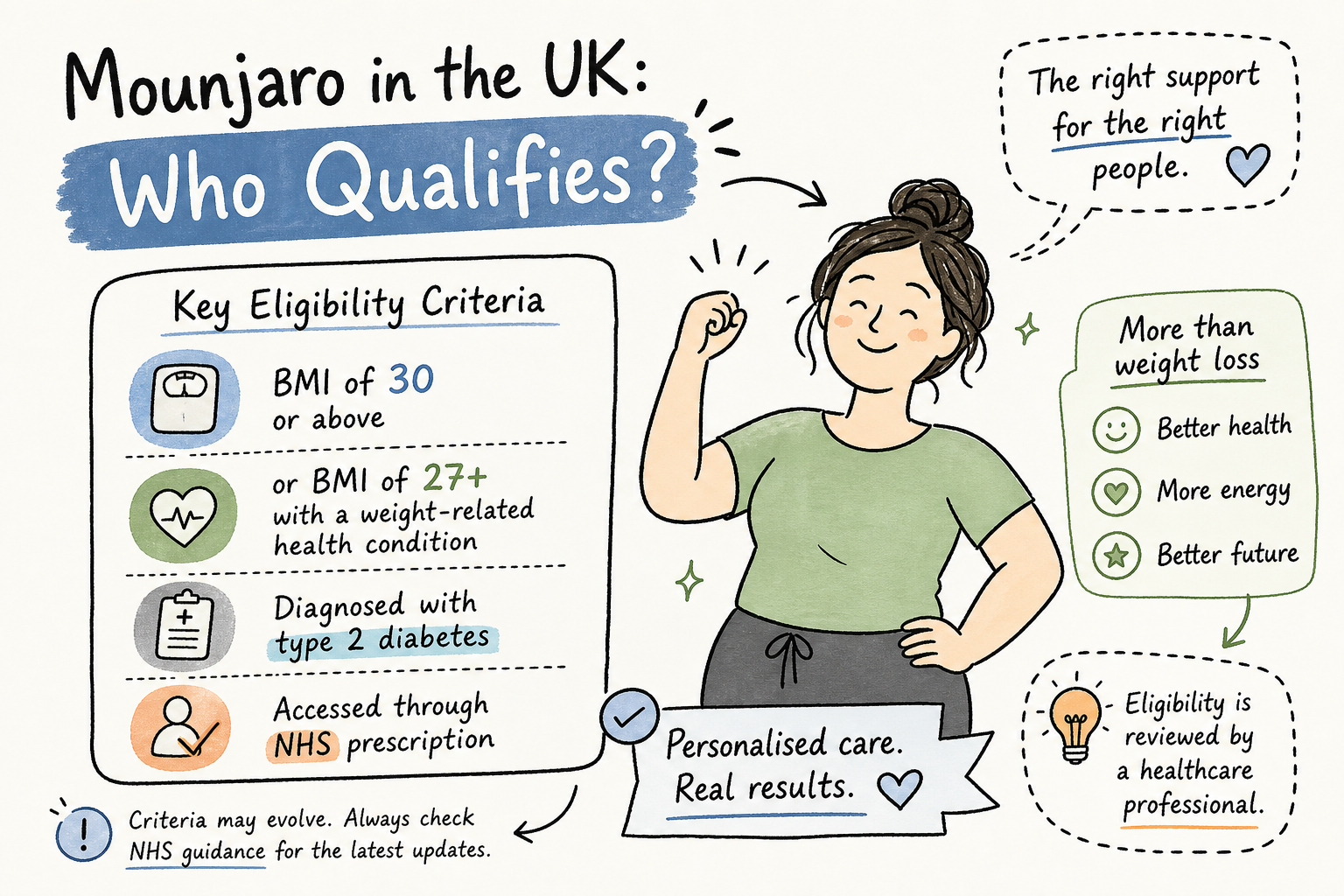
Private tirzepatide eligibility is considerably more accessible. The BMI threshold for a private Mounjaro prescription is 30 or above. If you have weight-related health conditions such as type 2 diabetes, hypertension, or sleep apnoea, that threshold drops further to a BMI of 27 or above. No GP referral is required. A large proportion of people in the UK accessing Mounjaro in 2026 are doing so through this route, and given the NHS cohort constraints, it’s easy to see why.
Ethnicity-based BMI adjustments
If you’re from a South Asian, Chinese, other Asian, Middle Eastern, Black African, or African-Caribbean background, the NHS qualifying thresholds are reduced by 2.5 kg/m², in line with NICE TA1026 guidance. The clinical rationale is well-established: the health risks associated with excess weight appear at a lower BMI in these populations. A BMI of 37.5, for example, meets the Cohort 1 threshold for someone in these groups. Many private prescribers also consider ethnicity-based risk adjustments when conducting their clinical assessment.
Qualifying health conditions that count toward Mounjaro eligibility
BMI is only part of the picture, particularly on the NHS. The number and type of health conditions you have plays a significant role in determining whether you qualify and which cohort you fall into.
The five NHS-defined comorbidities
NHS England has identified five specific conditions that count toward eligibility under NICE TA1026:
- Atherosclerotic cardiovascular disease (ASCVD): this includes ischaemic heart disease, stroke history, peripheral vascular disease, and heart failure
- Hypertension requiring treatment: a diagnosed condition currently managed with blood pressure medication
- Dyslipidaemia: raised blood fats, either treated with lipid-lowering therapy or confirmed through specific cholesterol or triglyceride readings
- Type 2 diabetes mellitus: established diagnosis
- Obstructive sleep apnoea requiring treatment: confirmed by sleep study, with CPAP or equivalent treatment indicated
These are the conditions most directly linked to serious health risk from excess weight. NHS England built the eligibility framework around them for that reason.
Why the number of conditions matters
For Cohort 1, you need at least four of those five conditions alongside the BMI threshold. Having fewer doesn’t necessarily rule you out of NHS access entirely: a specialist weight management service applies broader NICE TA1026 criteria and may still be able to help. For private prescription, having even one of these conditions can reduce your qualifying BMI threshold to 27 or above, opening the door for a significant number of people who sit outside the current NHS cohorts.
Who cannot take Mounjaro: medical exclusions explained
Not everyone is a candidate, and knowing the exclusions upfront saves time. Some are hard stops. Others require a careful clinical conversation rather than an automatic no.
Absolute contraindications
Mounjaro is contraindicated in patients with a personal or family history of medullary thyroid carcinoma (MTC) or Multiple Endocrine Neoplasia syndrome type 2 (MEN 2), per the MHRA-approved prescribing information. The link between tirzepatide and thyroid C-cell tumours has been observed in animal studies; while the human risk remains theoretical, the contraindication stands and no regulated prescriber will issue a prescription in these circumstances. Anyone with a known serious hypersensitivity to tirzepatide or other GLP-1 receptor agonists is also excluded, including those with a history of anaphylaxis or angioedema. For more on clinical safety and contraindications for GLP-1 receptor agonists, see this summary of evidence and safety considerations from a clinical reference source: clinical safety and contraindications.
Pregnancy and breastfeeding are absolute exclusions. If you’re planning to conceive, the medication should be stopped at least one month before attempting conception. Anyone under 18 is also ineligible: Mounjaro is not approved for use in paediatric populations. These three exclusions, pregnancy, pre-conception timing, and age, are non-negotiable regardless of which prescribing route you take.
Conditions that require careful clinical review
Several situations don’t automatically disqualify you but do require a prescriber to look closely at your history. Severe gastrointestinal disease, including gastroparesis, sits in this category. So does gallbladder disease and diabetic retinopathy. Type 1 diabetes is an important one to flag: Mounjaro is approved for type 2 diabetes only and should not be used for type 1 or other forms like latent autoimmune diabetes in adults.
Any reputable prescriber will take a full medical history before issuing a prescription. Expect questions about thyroid history, gastrointestinal conditions, any existing diabetes diagnosis, and reproductive plans. This isn’t bureaucracy; it’s the clinical step that ensures the treatment is actually appropriate for you.
NHS vs private Mounjaro: two very different timelines
Both routes exist and both are legitimate. But understanding what each one looks like in practice is essential before you decide how to proceed.
The NHS timeline reality
NHS wait times for Mounjaro through specialist weight management services currently run between 12 and 18 months in most areas, with some regions reporting waits closer to two years. Primary care access only began in June 2025 under the phased rollout, and GP participation is voluntary and varies between practices. Access also differs between Integrated Care Boards, so where you live affects how quickly you can realistically expect to start treatment. Many local NHS teams have published patient-facing guidance on tirzepatide and weight-loss medication; you can review a regional example of that guidance here: Weight Loss Medication: Tirzepatide (regional guidance).
The phased system was designed to manage overwhelming demand against limited NHS capacity. NHS England has been transparent about the scale of the challenge: with around 3.4 million potentially eligible patients and services under significant pressure, the rollout is deliberately measured. For anyone who doesn’t meet the strict Cohort 1 criteria, NHS access is likely years away rather than months.
Why private prescription is the route many people are taking in 2026
Private prescribers require a BMI of 30 or above, no GP referral, and typical lead times of one to two weeks from consultation to delivery. The trade-off is cost. NHS prescriptions are free when available; private prescriptions are paid out of pocket. In 2026, monthly costs range from around £133 for a 2.5mg starting dose up to approximately £330, £350 for the higher maintenance doses, depending on the provider. For anyone who meets the lower private threshold but sits outside the current NHS cohorts, the private route is the only realistic near-term option.
How to check your eligibility and what to do next
Reading the criteria is useful. Getting a clinical assessment is better. Self-assessing against a checklist doesn’t account for your full medical picture, and it’s that full picture that determines whether Mounjaro is both suitable and safe for you specifically.
The fastest way: a free consultation with a UK-registered prescriber
Dr Weightmans offers a free, secure online consultation reviewed by a UK-registered prescriber, no GP referral needed. The assessment covers your BMI, health conditions, and medical history to give you a proper clinical evaluation rather than a generic checklist. Dr Weightmans is a GPhC-registered service operating across a network of UK pharmacies, combining regulated clinical oversight with the convenience of a fully digital process. If you qualify for Mounjaro on a private prescription, treatment can typically be with you within a week or two of your assessment.
Going through your GP for NHS access
If you want to explore the NHS route, your GP is the right starting point. They can assess your BMI and comorbidities against the current cohort thresholds, refer you to a specialist weight management service where appropriate, and check your local ICB’s specific rollout timeline. Bring documentation of any diagnosed conditions to your appointment, having your diagnoses on record and evidenced speeds the process considerably, particularly when eligibility is tied to specific condition types and treatment status.
What to expect from a clinical assessment
Whether you go NHS or private, any legitimate prescriber will review your BMI, relevant health history, contraindications, and current medications before issuing a prescription. You’ll be asked about thyroid history, gastrointestinal conditions, reproductive plans, and any existing treatments for the five qualifying comorbidities. This is not a formality. It’s the step that ensures Mounjaro is clinically appropriate for you, and it’s what separates a regulated service from the kind of unchecked online platforms that should give anyone pause. To see if you qualify for Mounjaro, you can fill in the online consultation form which will be submitted to a clinical prescriber, who will issue a prescription if appropriate for you.
The bottom line: who qualifies for Mounjaro in 2026
Who qualifies for Mounjaro in the UK comes down to three factors: your BMI, the number of weight-related health conditions you have, and whether any clinical exclusions apply. On the NHS, the bar is high and the timeline is long. Cohort 1 requires a BMI of 40 or above with at least four of five specified conditions, and even then, wait times stretch into years for most people. On the private route, a BMI of 30 or above qualifies you outright, with the threshold dropping to 27 or above if you have relevant health conditions.
If you’re unsure where you sit, the most direct next step is a proper clinical consultation. A free online assessment with a UK-registered prescriber at Dr Weightmans gives you a clear, personalised answer based on your specific circumstances, not a best guess drawn from general criteria. If you’re weighing options between different medications, including a Wegovy vs Mounjaro comparison, that assessment will help you understand which treatment path is clinically appropriate.