BMI Calculator UK: Understanding Your Weight Loss Starting Point
Discover how to accurately calculate your BMI and understand what your results mean for your health and eligibility for clinical weight loss treatments in the UK. This guide provides you with a simple tool and the clinical context you need to take the next step in your weight management journey.
Your UK BMI Calculator
Use our simple tool to calculate your Body Mass Index. Enter your height and weight using either metric or imperial measurements to get an instant result. This number is the first step in understanding your current health status and exploring your options.
Understanding Body Mass Index: More Than Just a Number
While you now have your result, it’s important to understand what it represents. Body Mass Index (BMI) is a widely used screening tool that helps healthcare professionals assess if your weight is healthy in proportion to your height.
- What it is: BMI is a simple mathematical calculation used to place individuals into broad weight categories. It provides a standardised way to talk about weight and health risk.
- The formula: The calculation is your weight in kilograms divided by your height in metres squared (kg/m²). Our calculator handles this conversion for you automatically.
- What it measures: While not a direct measure of body fat, BMI correlates strongly with body fat levels and subsequent metabolic health risks for the majority of the adult population.
- Why it’s used: The UK healthcare system, including the NHS and private clinicians, relies on BMI because it is a quick, non-invasive, and reliable indicator of potential weight-related health problems.
The History of the BMI Metric
The concept of BMI dates back to the 19th century, created by Belgian mathematician Adolphe Quetelet. Originally known as the “Quetelet Index,” it was designed as a tool for studying populations, not for individual diagnosis. It was later adopted by the World Health Organisation (WHO) to standardise weight categories across the globe. Over time, its application has shifted from a population-level statistical tool to a common starting point in individual health assessments.
Research published by NHS BMI calculator shows that this is a well-documented area of ongoing research and practical application.
Why BMI is the Standard for UK Clinicians
In a busy primary care setting, BMI offers an invaluable baseline. Its ease of use allows doctors and pharmacists to quickly identify patients who may be at an increased risk of serious health conditions. A high BMI is clinically linked to the “Big Four” preventable diseases: type 2 diabetes, heart disease, stroke, and certain types of cancer. It provides a clear, objective number that can be tracked over time to monitor the progress of any weight management programme.
Interpreting Your Results: UK BMI Categories and Health Risks
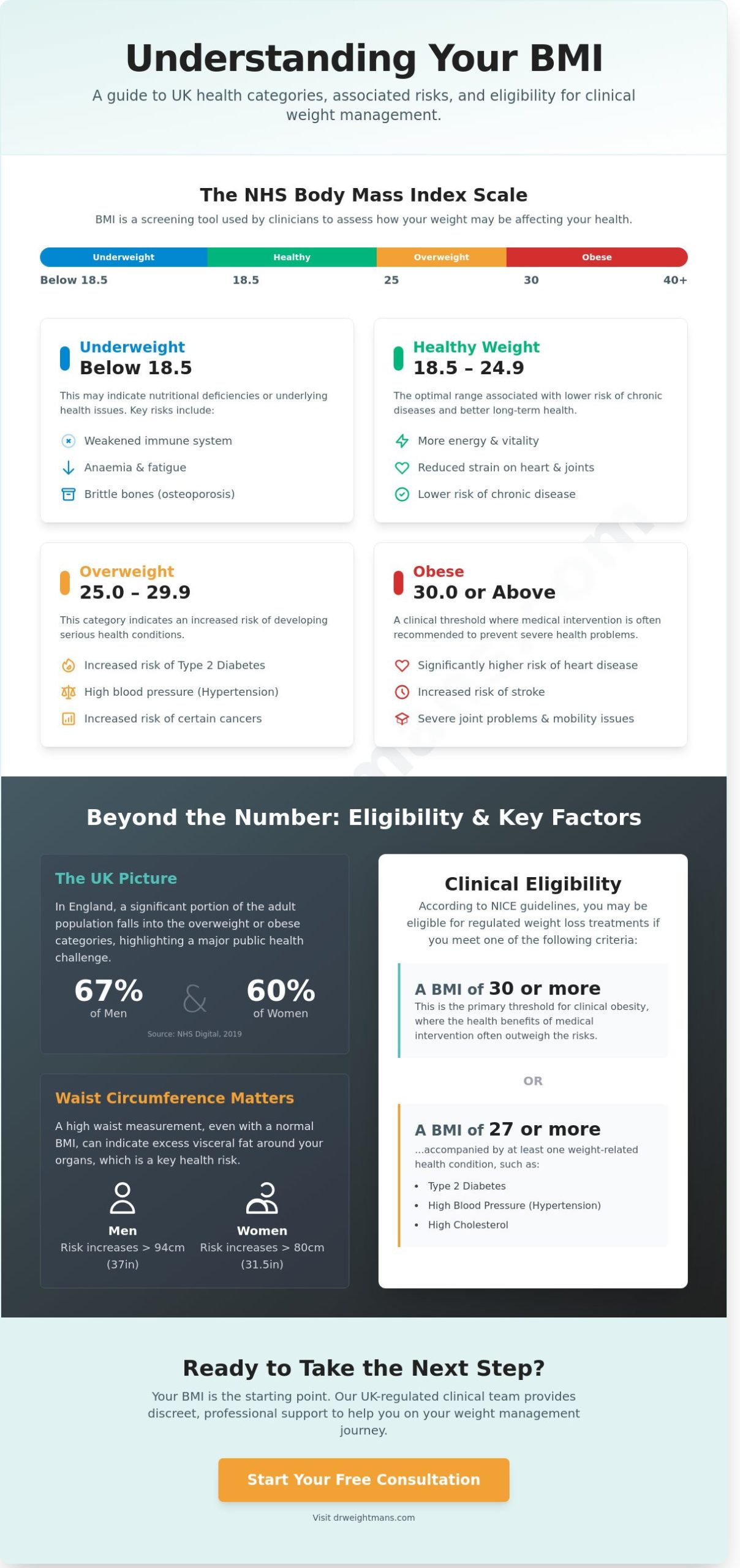
Your BMI result places you into one of four main categories, each with different health implications. Understanding where you sit is crucial for recognising your personal health risks and the urgency of taking action. It’s important to note that alongside BMI, clinicians often use waist circumference as a secondary measure to assess the distribution of body fat.
The Standard BMI Ranges for Adults
- Underweight: Below 18.5 – This may indicate malnutrition, osteoporosis risk, or other underlying health issues.
- Healthy Weight: 18.5 to 24.9 – This is considered the optimal range for minimising the risk of long-term, weight-related health problems.
- Overweight: 25.0 to 29.9 – Being in this category significantly increases your risk of developing conditions like type 2 diabetes, high blood pressure, and high cholesterol.
- Obese: 30.0 or above – This is the clinical threshold where health risks become severe. It is at this point that medical interventions, including prescription medications, are often recommended.
Ethnicity and BMI: Why One Size Does Not Fit All
Research has shown that the standard BMI categories are not equally applicable to all ethnic groups. People from some ethnic backgrounds face an increased risk of chronic diseases at lower BMI scores. For this reason, UK health guidelines recommend adjusted thresholds.
Research published by Official NHS BMI Calculator shows that this is a well-documented area of ongoing research and practical application.
- Lower Thresholds: For individuals of Asian, Black African, African-Caribbean, and Middle Eastern descent, a BMI of 23 is considered overweight, and a BMI of 27.5 or above is classified as obese.
- The Reason: This is due to differences in body composition and fat distribution. For example, the “South Asian phenotype” describes a tendency to store visceral fat around the organs, which increases the risk of metabolic syndrome and heart disease even at a lower overall body weight.
- Clinical Importance: Culturally sensitive assessments are vital. At Dr Weightmans, our clinicians take your full medical and personal history into account to provide the most accurate advice.
The Limitations of BMI: Why it Is Not a Perfect Science
It is crucial to recognise that BMI is a screening tool, not a definitive diagnostic test. It provides a valuable starting point, but it doesn’t tell the whole story of an individual’s health. There are several situations where BMI can be a misleading indicator.
- The “Bodybuilder Paradox”: The most common objection is that BMI doesn’t account for high muscle mass. Athletes or individuals with very muscular builds may have a high BMI that places them in the “obese” category, despite having very low body fat.
- Muscle vs. Fat: BMI cannot distinguish between weight from muscle and bone (lean mass) and weight from fat (adipose tissue). This is its primary limitation.
- Age and Sex: Body composition naturally changes with age and differs between biological sexes. For example, older adults may lose muscle mass (a condition known as sarcopenia), which can mask excess body fat if only BMI is considered.
- A Starting Point: For these reasons, BMI should be used as the beginning of a conversation about health, which is then supplemented by a clinician’s professional judgement and potentially other measurements.
Muscle Mass vs. Body Fat
Because muscle is denser and heavier than fat, a person with a high percentage of muscle mass can easily have a BMI score that misclassifies them as overweight or obese. Conversely, an individual can have a “healthy” BMI but a high percentage of body fat and low muscle mass, a state sometimes referred to as “normal weight obesity” or “skinny fat,” which still carries health risks. This is why a clinical consultation is so important to interpret the number in context.
Age and Pregnancy Factors
The BMI calculator is not intended for everyone. It is not an accurate measure for pregnant women, as weight gain is a natural and necessary part of a healthy pregnancy. Furthermore, this calculator is designed for adults aged 18 and over and should not be used for children or teenagers, who require specialised growth charts for assessment. As mentioned, the natural decline in muscle mass in older adults can also affect the accuracy of their BMI reading.
BMI and Clinical Eligibility: Accessing Weight Loss Treatments in the UK
For many, the most important question is: “What does my BMI mean for my treatment options?” In the UK, your BMI is the primary gateway to accessing clinically-proven weight loss medications. The National Institute for Health and Care Excellence (NICE) provides clear guidelines that clinicians use to determine eligibility.
- General Eligibility: A BMI of 30 or above (clinically obese) generally makes you eligible to be considered for prescription weight loss treatments.
- Eligibility with Comorbidities: The threshold is lowered to a BMI of 27 or above if you also have a weight-related health condition (a comorbidity), such as high blood pressure, type 2 diabetes, high cholesterol, or Polycystic Ovary Syndrome (PCOS).
- The Clinical Consultation: A calculator result alone is not enough. A thorough and confidential consultation with a registered clinician is required to confirm your BMI, discuss your health history, and determine if medication is a safe and appropriate option for you.
Qualifying for Wegovy and Mounjaro
Modern weight loss injections like Wegovy (Semaglutide) and Mounjaro (Tirzepatide) are prescribed in the UK based on these specific BMI tiers. They work by regulating appetite and food intake, making it easier to achieve and sustain weight loss when combined with lifestyle changes. Eligibility is straightforward: in the UK, a BMI of 30 or above (or 27+ with a related condition) generally qualifies a patient for medical weight loss support, provided other health criteria are met.
The Role of Comorbidities in Prescription Decisions
Weight-related comorbidities significantly impact your overall health and therefore lower the BMI requirement for treatment. Conditions like obstructive sleep apnoea, non-alcoholic fatty liver disease, or hypertension put extra strain on your body. By addressing weight loss, you can often improve or even resolve these associated conditions. A clinician needs to see this “full picture” to make an informed decision, which is why our online consultation process is so thorough. This must always be managed through a regulated UK pharmacy to ensure patient safety and treatment suitability.
Beyond the Calculator: Starting Your Weight Management Journey
Receiving a result that places you in the “overweight” or “obese” category is not a personal failure; it is the identification of a manageable health condition. The number from the calculator is simply a starting point, giving you the clarity needed to take meaningful action. At Dr Weightmans, we are here to help you navigate the next steps with professional, discreet, and empathetic support.
- Reassurance: A high BMI is a clinical indicator, not a judgement of your character or effort.
- The Next Step: After getting your result, the next logical step is to seek a professional medical opinion on your options.
- Discreet Consultation: Our secure online consultation allows you to discuss your health privately and conveniently, without the need for a face-to-face appointment.
- Comprehensive Support: We believe in holistic care. Prescription medication is a powerful tool, but it works best alongside guidance on diet, exercise, and lifestyle adjustments.
Taking the First Step with Dr Weightmans
We have designed our service to be as seamless and supportive as possible. Our digital consultation process allows you to securely share your health information with our UK-registered clinicians from the comfort of your home. We prioritise your privacy and discretion at every stage, from the initial assessment to the express delivery of your treatment. We encourage you to move from calculation to action and find out how we can support you.
Empowering Your Health Journey
Achieving a healthier BMI has profound long-term benefits, from reducing your risk of chronic disease to improving your daily energy levels and overall quality of life. Our approach combines the heritage and trust of a physical pharmacy network with the ease and accessibility of a modern digital service. We are committed to being your partner on this journey, providing the tools and support you need to succeed.
Empower Your Weight Management Journey – Start a Consultation
Frequently Asked Questions
- How accurate is a BMI calculator for someone with a lot of muscle?
-
A standard BMI calculator can be inaccurate for individuals with high muscle mass, such as athletes or bodybuilders. Because muscle is denser than fat, it can inflate the BMI score into the “overweight” or “obese” range, even if body fat is very low. In these cases, a clinician would use other methods like waist circumference or body fat percentage analysis to get a more accurate health assessment.
- Can I use this BMI calculator if I am pregnant?
-
No, BMI calculators are not designed for use during pregnancy. The natural and healthy weight gain required for a developing baby will make the BMI result an inaccurate and unhelpful measure of your health. You should always follow the specific weight guidance provided by your midwife or obstetrician.
- What is a healthy BMI for a woman versus a man?
-
The standard BMI categories are the same for all adults, regardless of biological sex. The “healthy” range is 18.5 to 24.9 for both men and women. While body composition (the ratio of fat to muscle) naturally differs between sexes, the general BMI thresholds for health risk are considered universal for adults.
- Why do Asian and Black African backgrounds have different BMI thresholds?
-
Extensive research shows that people of Asian, Black African, and other ethnic minority groups can have a higher risk of developing conditions like type 2 diabetes and heart disease at lower BMI levels. This is due to genetic differences in body composition and how fat is stored. For these groups, a BMI of 23 is the start of the “overweight” range, and 27.5 is the threshold for “obese.”
- What BMI do I need to be to get Wegovy on prescription in the UK?
-
According to NICE guidelines in the UK, you are generally eligible for a Wegovy prescription if your BMI is 30 or above. The threshold is lowered to a BMI of 27 or above if you also have at least one weight-related health condition, such as high blood pressure, type 2 diabetes, or high cholesterol. A full clinical consultation is required to confirm eligibility.
- Does BMI take my age into account?
-
The standard BMI formula does not directly factor in your age. The same healthy range (18.5-24.9) is used for all adults over 18. However, a clinician will always consider your age as part of a holistic health assessment, as body composition changes over a person’s lifetime.
- What should I do if my BMI result says I am obese?
-
If your BMI is 30 or above, the first step is to speak with a healthcare professional. This is a clinical indicator that your weight may be posing a significant risk to your long-term health. You can start a confidential online consultation with Dr Weightmans to discuss your result and explore safe, regulated treatment options available in the UK.
- Is BMI the same thing as body fat percentage?
-
No, they are different measurements. BMI is a calculation based on your height and weight, used as an indirect indicator of body fat. Body fat percentage is a direct measurement of how much of your weight is composed of fat tissue. While BMI often correlates with body fat percentage, it doesn’t measure it directly.